Showing posts with label tel aviv university. Show all posts

Thursday, April 8, 2010

Dr. Rosenberg 6D, meet Dr. Rosenberg 6F Or “A Rosenberg by any other Name”


Rosenberg is not a rare last name, if you're Jewish and live in Israel. Yet, among the hundreds of flights I have taken to and from Israel, I had never sat next to another Rosenberg, unless a member of my immediate family. That is, until this past Thursday. I got on my Lufthansa flight (Tel Aviv-Munich) and looked back to my seat, 6F. Next to my seat, an ultraorthodox Jew reading a religious text with the same Dr. Rosenberg on his boarding pass. The steward was quite confused. It didn't look like an auspicious start to my flight. Hello, hello, and that's it, I think to myself, and best to ignore him the rest of my trip.


How wrong first impressions can be. The man turned out to be Rabbi Dr. Jur. Berysz (Dov) Rosenberg from Zurich. He is not only an ordained rabbi who writes books on halacha (interpretation of Jewish law) but also a doctor of law who handles international legal disputes on insurance issues. I'm not finished. This prodigious fellow has twelve children and more than thirty grand children, kein ein ahora. Also, an owner of a small sticker printing company (etty-ketty). One of the most impressive, colorful and interesting passengers I have ever shared rows and seats with.


I ask the scholar to answer a question that has been plaguing me for many years. Is an observant Jew allowed to smell the odor of bacon? What should he do if his neighbor is barbecuing what Israelis facetiously call 'white meat' (pork to everyone else)? Close the windows? Sell the house? What if the neighbors are Jewish?


The rabbi surprises me. It turns out that there is no law prohibiting a religious Jew from smelling even the traifest of the traif (unkosher, I am thinking here a double cheeseburger granished with shrimp). I ask him whether the enticing odor might lead a religious man into transgression (there are laws, for example, prohibiting the handling of money on Shabbat for similar reasons). "What", he answers, "do you really think a religious Jew is going to eat hazer (pig) just because he smells it?"


Our conversation then takes an interesting turn. There are many blessing that Jews are supposed to invoke during the day. There are blessings for waking up in the morning, for eating various kinds of food. Even smell blessings, as for example when you smell the spice box on Saturday evening, as the Shabbat (Sabbath) ends. Turns out that is also a smell blessing for the 'etrog' (a citrus used during Tabernacles). What about smelling other foods? After all, it is well known that the smell of freshly baked bread spreads happiness and an urgent desire to buy practically anything (after all, that is why supermarkets have bakeries). However, among the sages, there is a disagreement as to whether the smell of bread itself warrants a blessing in its own rite. Because of this dispute, very religious Jews are supposed to refrain from smelling baking bread, lest they risk the dilemma of wondering whether to bless what should not be blessed, or not to bless what should.


So, folks, in case you were wondering: A very observant Jew, encountering his neighbor's barbecue, is not required to take any affirmative action whatsoever, even if the neighbors are Jewish and barbecuing pork chops and they smell really good (the chops, that is). On the other hand, if the same neighbor bakes a loaf of bread, the observant neighbor must close the windows and go for a long walk. As they say, go nose.

Sunday, March 14, 2010

How Bird Brain was Hatched


Any visit of Jeff Pulver to Israel is in itself a reason to celebrate. And we do. Here at Afeka College, my new ‘home’, we have a special relationship with Jeff, as he is the first international member of the Board of Governors of the College.

Earlier this year, we hosted Jeff’s 140 Conference here, and when we found out that he would be here for Purim, we (Sharon Ariel and I) rushed to organize one of Jeff’s networking breakfasts.But we figured that it would be a shame to have hundreds of interesting and creative people here just for an hour or two of schmoozing. Why not add some kind of program/symposium following the fun?


Since we are at an engineering college, my first idea was to have a symposium focusing on the future of mobiles, or something equally geeky. But Jeff sent me a Facebook message suggesting that I look for a subject that I am passionate about.


Needless to say, I am passionate about creativity: teaching creative thinking (my first job at Afeka College, together with Alon Amit, was teaching a course called the ‘Art and Science of CreativeTthinking’), and sharing the culture and spirit of creativity. In this context I profess to be a follower and disciple of Yossi Vardi, who has been spreading this bug in Israel and abroad over the past years (more on that later).


So the first idea was a symposium on creative thinking: can it be taught or naught? Here at the college, we have a rare ensemble of full-time and part-time staff (and even students) who use creative thinking methodologies (TRIZ, SIT, brainstorming, etc.) in their courses. But this might quickly turn into a wrestling match between people proposing the various techniques. Also, it would be unidirectional and informative, a bunch of talking heads, rather than experiential.


Enter the un-conference. The un-conference is a meeting in which there is a high level of democracy. In other words, the people attending can suggest themselves as speakers, as well as the topics they choose. The schedule is dynamic and sometimes spontaneous. Wondrous things can happen in the class and outside as well.


So I contacted Yossi and asked for his moral support. He agreed, and suggested that we work together with one of his up-and-coming youngsters, Noam Fine. Noam and I met up briefly at the DLD in Munich, and then at the Arcaffe at Shuster Center (one of my favorite haunts, I used to perform there a decade ago when it was called “Rinchi’s”). Following some uffish thought, we settled on an un-conference on creative spirit and named it “Bird Brain”. Noam added the 10 to make it look respectable. He also designed the logo, set up a wiki. We enlisted the formidable organizational skills of Sharon Ariel (head of marketing at the college) and thus the un-conference was born.


So what went on at Bird Brain 10? In the auditorium, we had an eclectic mix of birds sharing their thoughts, visions, and art. Yossi talked about silliness as next to creativeness, and brought Noa Vax to the stage for an impromptu microphone tapping percussion solo. The next batter up was Yossi’s formidable brother Didi who talked about amazing useless things (two of which are on permanent display at the college). The Vardi brothers were followed by thespians, orators, musicians, magicians, conductors, inventors, patentors, and more. Presiding over the meeting on Mor’s perch was Max the talking parrot, who had very little to say, and was very popular as a result.


Outside, Hagai Cohen eggzibited his printer-organ, Moti Sokolov, president of the college rode on Didi Vardi’s walkcycle, Yossi Matias googled on the piano, while Ilil gave out delicious jam samples (jam session with jam), Aviva and Jehudi gave out smiling roses. There were lots of smiles.


You had to be there. If you weren’t, well we plan to have Bird Brain 11 on the day right after Purim, 2011.

For more on Bird Brain you can check out:


Managing Greatness
Appreciating and encouraging greatness

Best of BirdBrain
by Gil Reich on March 3, 2010

Sunday, November 1, 2009

A Door Closes, A Window Open


A Door Closes, A Window Opens

In December, 1973, I flew back to Ottawa for my brother David's bar mitzvah. A week or so after the simha, I was surprised to receive a telegram (phone call? I can't remember) from Tel Aviv University.

"Where are you?" they wanted to know. A week before the Yom Kippur war, I had taken the bus from Jerusalem to Tel Aviv to interview for a graduate position there as a M.Sc. student /teaching aide. The following week, the war erupted and the next two months were turmoil.

Nevertheless, school had now started again in Israel and I was expected back, to teach and study. I remember sitting on the plane back to Tel Aviv with a religious man who told me that the world was going to end soon, and that the battle of Gog and Magog (Armageddon) was imminent.

Thus began my romance with Tel Aviv University that lasted thirty-six years. I did my graduate degrees there (with a 30 month hiatus for army duty), hung out at Gilman, lived intermittently in the dorms (the same ones that still exist!), did some crazy things at the pool that I cannot share, fell in love, landed a tenured position at the Dental School and more recently Medical Faculty, and made a decent career as a 'bad breath guru'. I even brought the university some four million dollars in revenues from several inventions.

In two weeks I turn 58 and could continue as a tenured professor there for another decade. But I have decided to call it a day. There are many reasons for this, but perhaps the main one is that I have many interests, aside from being a microbiologist (or scientist, for that matter), and this university (and most others) want their professors to be very focused and to maintain the very same specialty throughout their careers. In other words, if you come in as a young lecturer teaching bacteriology in your thirties, you are expected to be teaching the same subject thirty-five years later.

That works for many of my colleagues, who are delighted to hang out in laboratories for decades focusing on a singular path towards stellar success in a very specific scientific area. But for those of us who become easily distracted by other loves such as music, creative writing, thinking and other 'wastes of time' the academic trajectory becomes a strait-jacket.

Some of my favorite scientists followed meandering careers. Louis Pasteur, who started out as an amazing chemist and followed his nose into microbiology and other biological pursuits and my own professor, Eugene Rosenberg who also began in chemistry and found a new and amazing career in bacterial behavior. I also remember the late Herman Epstein, whose amazing career kept morphing (I was witness to his main morph, as he started studying the development of rodent brains in response to educational development in the 1970s).

For many years, my research on bad breath saved me. I was able to look at not only the microbes that cause the smell, but also the smelly substances, and the psychological implications of smelling and being smelled. I invented gizmos and mouthwashes. I interviewed thousands of people and learned a lot about humanity. The breadth of breath research was satisfying for me. But when I left the dental school for the medical faculty five years ago, I was expected to morph back into a regular bacteriologist and teach medical bacteriology much the same as it was taught when I was a student in the early 1970s. I tried, but eventually decided that this was wrong. I cannot teach medical students subjects in which I am neither up-to-date, nor particularly interested.

And so, from December 1st, one month from now, I will become an 'emeritus professor' at Tel Aviv University. I will maintain my office and laboratory (the latter will likely diminish in size and manpower of time) and will continue, part-time, my work on the causes, diagnosis and treatment of bad breath and related issues. I will also do some teaching, but only subjects that I feel passionate about.

My original retirement plan was to spend less of my time at the university, and invest more effort in my other pursuits, i.e., playing and singing jazz, writing children's stories, and teaching multidisciplinary creative thinking. I sent a message to the President of Afeka Engineering College, Prof. Moti Sokolov, asking him whether I would be continuing the course in creative thinking that I had given over the past few years with Dr. Alon Amit. Instead he called me in and invited me to be the Dean of Students of the college.

Flabbergasted, I accepted. During all my years at Tel Aviv University, I was never asked or elected to run or administer anything (always considered too much of a scatterbrained nonconformist). When I applied for the position of Rector of Tel Aviv University a few years ago, the nomination committee treated me with such kindness and compassion that I knew it was hopeless! I certainly hope that the qualities that made me such a round peg in a square hole will now work to my advantage!

So, from Dec. 1st I start a new and exciting career, hoping to help the college shape and sharpen the minds and careers of 2000 youngsters. Afeka, here I come.

Sunday, August 16, 2009

Bye Bye Love

(Pictured from left Professor Mel Rosenberg, Professor Danny Levitan, Rector, Tel Aviv University)

Bye Bye Love

I have spent most of my life at Tel Aviv University, student, lecturer, professor. I started out 36 years ago as a starry-eyed young M.Sc. student, right after the Yom Kippur war. Lat week I submitted my letter requesting early retirement. There are many reasons for my desire to retire eleven years early, some stemming from my own personal journey, which has been diverging from the university's path for some years. Though I am critical of what is transpiring on campus, I love the university, and it has been an integral part of me. Here I fell in love, became a scientist, and enjoyed a career as scientist and inventor.

Yesterday I chanced upon the log book I kept as a Ph.D. student. On Nov. 18th , 1979, I carried out a little experiment which showed how readily bacterial cells become attached to oil droplets. It formed the basis for my thesis work, and a significant part of my subsequent career. http://garfield.library.upenn.edu/classics1991/A1991FE76400001.pdf
As a retiree, I will maintain an office here at the Medical Faculty, and a research lab, and I plan to continue my current studies on bad breath and related topics. And of course, not being involved in university administration will hopefully allow more time to write children's stories and perform and sing for both adults and kids. See http://www.melrosenberg.com/ to learn about everything I love to do.


Monday, June 22, 2009

The Un-iversity

The Un-iversity

Once in a while, my dream of starting an un-iversity comes back to "haunt" me. After over thirty years at a regular university (Tel Aviv University), I am aware of the shortcomings of ordinary academia.

1. The students are degree-oriented. The want to take a course, get a y average, to get a degree in z.

2. Teaching is mostly mediocre. This is because the teachers are paid primarily to do research and don't care that much about giving inspiring lectures. Often they give the same lecture over and over again for decades.

3. The university usually discourages lateral thinking among faculty. This is because universities are arranged according to disciplines, faculties and departments. You become a professor in a specific area (microbiology in my case) and are pigeonholed to teach and research in that field your whole career. Focusing, on the other hand, is highly encouraged.

4. Many of the most intelligent and successful people on the planet never finished university, let alone completed a Ph.D. No matter how motivating, enlightening, and innovative they are, they would never get a research or teaching appointment at a good school.

5. University courses are structured. They have predetermined programs, specific curricula, have course outlines, etc.

6. Universities often prize and teach so-called "knowledge", rather than the paths and processes of mental development.

7. Universities tend to elect officers who believe in routine and resist change

8. Universities tend to accept students who do well in routine examinations under routine conditions.

So, what would an un-iversity be? I am not sure, but we could share a few thoughts.

1. It would prize innovation and lateral thinking.

2. The emphasis would not be on obtaining marks or a degree.

3. The faculty would me more interested in sharing thoughts and enthusiasm than making a salary.

4. Innovation, creativity, curiosity are words that would be commonly used.

5. The students would make a difference.

6. Not all the teachers would be required to have advanced degrees, though some of their students might.

In my next blog:things I would like to learn that no one is teaching.

Tuesday, April 29, 2008

The Moral Bankruptcy of Tel Aviv University

Tel Aviv University is having financial difficulties. As a public campus, some of the burden for this lies on the State of Israel, but some of the responsibility lies on the shoulders of those who have been running our university.

One of the most irksome issues is that of applied research. Weizmann Institute brings $100,000,000 a year from royalties of service inventions. The Hebrew University brings $40,000,000 a year. And Tel-Aviv University? Only a few millions a year. In fact, for years, most of their royalty stream derived from three service patents from my own laboratory.

I have been writing to University administrators for years, hoping that they would realize that the continued humiliation and denigration of the few professors who have succeeded in actually developing successful projects is to their own detriment. Our university has a track record of being vindictive towards its own inventors, misappropriating significant parts of their research budgets, and ridiculing their success. No wonder they bring in such paltry royalty streams.

For over twenty years, the university followed its own patent by-laws dating back to 1977. Certain sections were given an interpretation which the university sanctioned over the years. In particular, 20% of the income from patent royalties was directed to the laboratories of the inventors. However, over the past five years, the university has unilaterally begun siphoning off and misappropriating significant amounts of these research funds. According to my calculations, the university owes my laboratory over $250,000 in research funds. For all I know they have been using this money to support unrelated research, 'pet projects' or even to cover the expenses of their own management (or mismanagement, as the case may be). The university recently chose to compose a new set of patent by-laws for new inventions, which are constraining and self-defeating. The attempts of applied researchers all over campus to prevent this unilateral step were largely unheeded. A meeting scheduled months ago with the new President of the university was never held (to the best of my knowledge).

After appealing to every possible address at Tel Aviv University, from the dean of my faculty to the general manager, rector and the president of the university, with no response whatsoever, I have no recourse but to bring this to the public knowledge, by writing a series of monographs, explaining how the university has taken the low moral road. Unfortunately the problem with applied research is just the tip of the iceberg. The university's lack of moral fiber extends to its cynicism in mistreatment of its own students and its donors, and its lack of vision for the future.

I must emphasize that I love Tel Aviv University (but not its administration). My conscience will not allow me peace unless I start telling it like it is. As an employee talking out against his management, I assume that there will be repercussions. But I will no longer be silenced.

Please let me know what you think.

Mel Rosenberg, Ph.D.

Professor of Microbiology

Sackler Faculty of Medicine.


Sunday, February 3, 2008

Campus of mediocracy

Let me start out by stating clearly that the problems of Tel Aviv University which I will be discussing are as much my fault as anyone else's. I wouldn't like to give the impression that I am blaming others, I think we are all to blame.
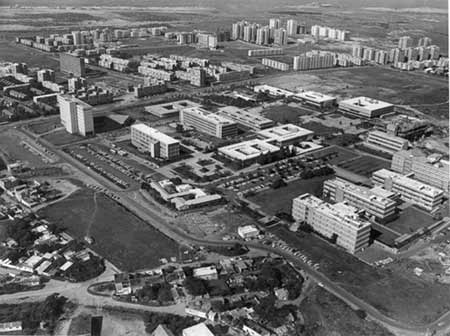
In the early 1970s, I moved to Tel Aviv University as a young master's student. What a welcome escape it was from my undergraduate days as a chemistry student at Hebrew University. The University was young, most of the professors insisted on being called by their first name. Dan Ben Amotz could be seen wandering around campus barefoot (or almost barefoot) on his way to attend Kroy's crazy philosophy lectures.
There were few buildings and lots of sand, mud, and wild vegetation. I remember almost getting hit by lightning walking between life sciences and the medical school.
Over the past thirty-five years the university has sprouted a lot of concrete, and manicured lawns. I think it is a handsome campus. But I liked it better when it had more wild spaces.
I loved and still love our university, lived at the dorms, moved up through the ranks, fell in love on campus, and made it my career. I have also been involved in one of the few inventions that brings the university millions of dollars in licencing revenue.
From the 1970s to the present we have suffered from a string of mostly mediocre and sometimes cynical and self-serving administrations. One consequence was that our university went straight from youth to old age. We have now largely become a city college.
Students come, fill large halls, and go back home at six p.m. At night, when the city lights up, the university closes down. I couldn't even get the administration to consider lighting up the med school at night.
Our students have learned from us to become largely cynical, especially after the last strike. They want their degree, with as little effort as possible. And we oblige, teaching them with as little effort as possible.
I spent twenty years at the Dental School. The School was for many years run like a feifdom, the administration was self-serving, and ruled by intimidation. The teachers and researchers were intimidated by the administration, and took it out on the students. But when I made efforts to alert the University at the highest levels (both academice and administrative) to the situation, I was ignored and silenced. They let sleeping dogs lie until the deficit of the School could no longer be noticed. And then the shit started flying. We are left with half a Dental School, one that never had much of a research program and still does not.
In the Human Microbiology Department of the Medical Faculty where I now work, professors reaching the age of pension have not been replaced by young faculty. Those that have replaced them have mostly either fled or were not given tenure. Within a few years, there will not be any bacteriologists at all in the Medical Faculty. Does anyone care? Not really.
In the American medical program, sometimes five or less students attend classes (out of a class of 70). They say it's because we are not good enough teachers. Does anyone care? Not really.
Are there any staff or students of TAU out there reading this who think that we really care about our students, that we take pride in our teaching, that we care about our own university as much as we did twenty years ago? I challenge you to step forward.
Of course it's easy to blame VATAT and the budget cuts, but that ignores the dwindling return that the public sees on its own investment in our university.
Are we really doing lots of research that is groundbreaking? relevant? important?
Here is another point to ponder. Professors are paid the same salary whether or not they teach well, whether or not they publish research (I know some who stopped doing that years ago). There is no scale of excellence. On the contrary, professors who work hard at the university but also consult on the side (these are probably the more successful and community-oriented ones) actually get paid much less salary than those who profess to spend their 'full time' at the university, whether or not they do anything whilst there.
Mediocre administration breeds mediocre teaching and eventually leads to mediocre research. After all, the students we teach today are doing most of the research five years from now. I know that our university has international stars, but I have the feeling that we are for the most part so-so. It's hard to give a damn when the bosses of your bosses don't. We have suffered over three decades of cynical, mediocre leadership. And this breeds mediocrity in all facets of our campus.
Why should university professors try harder? There are fewer and fewer reasons. Success at our university goes unrewarded, and professors who do 'too well' in basic and applied research can find themselves with problems at the department level, especially when their own department is mediocre and jealous. Our university pays lip service to the need for innovation, but does little to encourage it. It recently rewrote its patent bylaws, and forced them down the throat of the applied researchers throughout the university. Does anyone on campus care? Not a wit.
Weizmann brings in 100 million dollars a year in royalties. Hebrew U about 40. Tel Aviv University? just a million or two (a significant part of it from my own inventions). The numbers speak for themselves.
We do not encourage innovation. The university's most famous and successful innovators have suffered quite a bit of humiliation over the years. The university does not really care. Tel Aviv University does not even send its own professors to give courses on innovation. The two courses on innovation given at Tel Aviv University that I know about are both outsourced! The only way I have been able to give a multidisciplinary course on innovative thinking (together with Dr. Alon Amit) is at Afeka engineering college. I have never be allowed to give such a lecture series on my own campus (I have tried). We have a new president with an outstanding personal record, but I continue to be pessimistic. If, as I stated above, we have relegated ourselves to the level of a city college, then five years from now we will have no raison d'etre whatsoever. After all, the 'michlalot' do a better job at being city colleges than we can. Some of them actually reward and pride themselves on good teaching.

Wednesday, May 30, 2007

Why I love the UK

Bad breath has been good to me. I write these words in the lobby of the Thistle Marble Arch, near Oxford Street right next to Marble Arch and Hyde Park. I'm on my way home in a few minutes, after five days dedicated to the two-phase mouthwash which I invented and help develop, first in Israel, then in the UK. As I write, the invention (Dentyl pH) has become a hit here. One out of every five (!) mouthwash bottles sold in the UK is Dentyl pH.

I walk into drug stores all along Oxford Street, and stand beside my mouthwash bottles, admiring them as if they were some kind of progeny. No matter that I don't own the patent (the university does). No matter that the millions of people using it have no idea who invented it. The important thing is that they are improving their oral hygiene, self esteem, and social lives, rinsing and gargling with a product that I nutured for so many years, in the face of criticism and nay sayers.

The mouthwash story is one of pure luck, happenstance and chance. Louis Pasteur, one of my scientific heroes of all time, said that "Chance favors the prepared mind". If that's the case, then the only credit I can take is cherishing the unexpected. Most of the turning points in the development of this product were born out of accidents and flukey experimental results. Only very few inventions succeed in becoming products, and among those few products, most fail commercially. So the success of the mouthwash is rare indeed. And as someone with quite a few patents, and less-than-successful products, I know just how lucky I am.

I'm attaching a picture I took this afternoon of the 'baby' at a Boots store on Oxford Street.

The UK success has made me even more of an Anglophile. I love London, the Queen, the royal family (I've heard that the Queen may have a breath problem, I'd love to help her out, why doesn't she just ask me?). After all, I grew up as a British commonwealth subject in Ottawa, I collected coins displaying the Queen and her predecessors. I sang the British anthem at movies and football games. Actually as a child, I got the words wrong, thinking that the second part went:

"Send her Victoria, Happy and Gloria…"

I thought that these were the Queen's children, missing during the Second World War.

I've had a good trip, meeting reporters, explaining how the mouthwash works (at least how I think it works). This included a fancy Japanese lunch overlooking the Thames, and tea at Claridge's (including, inter alia, lavender flavored chocolate sweets, in honour of the Chelsea flower show). And an overnight train trip to Harrogate, an enchanting spa resort in Northern England.

Most important of course, as always, is meeting up with the friends I've made here over the past decade. A lovely island.

Thursday, April 5, 2007

What I do for a living

People call me Mr. Bad Breath to my face, other things behind my back ("Honey, do you know what Mel Rosenberg actually does for a living? He sticks his nose into people's mouths and smells their breath!"). When I was that pudgy kid growing up in Ottawa, I originally wanted to be an astronomer. But I ended up doing my Ph.D. in microbiology. When I joined the dental faculty of Tel Aviv University as a young lecturer in 1982, I wanted to do something new, but didn't know precisely what. At the time we were commencing work on our two-phase mouthwash project and someone told me to check whether it worked against bad breath. I went to the library and found that very few academic scientists (Joe Tonzetich at UBC, Ken Yaegaki in Japan, and maybe one or two others) were working on this very common and embarassing problem. I remember coming home that night and telling my wife that I had stumbled onto my scientific future. Indeed, I've been very lucky. We developed a method for measuring the volatile sulfides associated with bad breath (the Halimeter) that is used in laboratories and clinics around the world. In addition, the reformulated two-phase mouthwash (Dentyl pH) has taken off in the UK and is a highly successful product there. I was also fortunate enough to write an article on bad breath for Scientific American in 2002. These days I'm on sabbatical, writing a book on bad breath (following two edited scientific texts) for the public, working on our new website (www.smellwell.com), and trying to get our anti-odor flavor ("Breathanol") into more products in more countries. In August, I'll be joining scientists from around the world at the 7th international conference on breath odor, which will be held in Chicago. This is especially exciting for me as I co-founded this society in 1996 with Prof. Daniel van Steenberghe, and we have watched it grow and develop. These days, Alon Amit and I are working on fixing the entry for bad breath in 'wikipedia'. The current one really stinks (literally as well as figuratively). It will be interesting to see whether they accept a more scientific, less commercial version. Stick around to find out soon.