Showing posts with label innovation. Show all posts

Monday, April 14, 2008

48create - creative thinking method

About two years ago, I was approached by the President of Afeka College, Prof. Moti Sokolov. He had heard (quite correctly) that I was interested in taking a sabbatical, and teaching an interdisciplinary course at the undergraduate level. This is practically impossible at large, conservative, departmentalized universities, but Afeka is a top notch community college, focusing on engineering students.

The topic which we decided upon was "multidisciplinary creative thinking". Moti's stipulation was that the course be given in English. I happily agreed.


To develop and present the course, I enlisted my right hand man (literally, being left-handed myself), Dr. Alon Amit. Alon a young man of multiple talents and pursuits: internet whiz, dentist, cook, entrepreneur and chocolate aficionado, inter alia. We found that there are over fifty different techniques for creative thinking available. After looking at many of them, we decided to develop our own interactive course, bringing together a unique mix of internet and science, poetry and patents, copy writing and technology.

There were several important features of our course:

Fun, silliness and active participation were encouraged and pursued. Applause and praise were welcome; constructive criticism was tolerated. Each student was issued with the name badge of a famous pseudoparticipant. Thus, during the course, each student went by the name of his/her particular namesake: Sir Isaac Newton, Margaret Thatcher, George Gershwin, etc.


Most of our 'get togethers' were composed of a mosaic of different 'corners', including

  • vignettes from movies and advertising
  • inventions with 'legs'
  • famous innovators (this included writers and musicians as well as inventors)
  • riddle solving and composing
  • trying to improve erstwhile mundane objects and processes
  • show and tell

A few of the lectures were more focused, and less interactive, relating to specific subjects, such as

  • protection of ideas
  • current methodologies for creative thinking

We often wandered off the game plan, allowing ourselves to meander laterally on a wide variety of tangents. For example, a word which the students didn't know might lead us to a poem, song or website (we were online the whole time). These unanticipated outings were great fun and engendered the lots of creative thinking. If Alon and I otherwise discovered a classic movie, poem or innovator that the students were unaware of (for example Andrew Marvell's marvelous "To a Coy Mistress"), then the students were instructed to seek out the poem and we read it together during the next class. We 'rediscovered' Tom Lehrer, Monty Python, and Bing Crosby, just to name a few. They also brought in their favorite inventions, video and audio clips.

To get a high mark, students needed to actively participate in class and via e-mail during the week. They would get 'bonus points' for anything and everything clever, original and funny. The course assignment was to submit a written proposal for an innovative restaurant.

I must admit that we didn't anticipate how successful the course would be. The 40 engineering students that participated in the course had vivid imaginations, were great in lateral thinking (when encouraged to do so), and rose to the many challenges of the course. They developed splendid and sometimes hilarious ideas for innovative companies, improved existing products, invented restaurants of all kinds and shapes.

During the classes, we discovered that certain approaches worked better than others.

For example, we found that in order to 'think outside the box', it helps if you have a box. We discussed various ways that you can modify a product or process (e.g., changing various physical properties). But the students' and our own ability to think of new innovations worked best when we gave them examples of things to change.

This led us to the development of a very simple process which we now call "48create". According to this method, we give the students a list of 48 ways to change the world, and 48 things to change (of course the ways and things can both be modified and adapted).

Then we pick (randomly, or on purpose) several from each list. So, for example, the things we might want to change might be:

  • Coins
  • Ping pong ball
  • buttering bread
  • Parking space

The four ways might be:

  • Color
  • Direction
  • Frequency
  • Size

The advantages of this technique are its simplicity, and that it works. I tried it out at the University of Toronto last September, and within a few minutes, science students were busy discussing new (and very ingenious!!) of keeping maple syrup from rolling off buttermilk pancakes.

One important aspect of the technique is that it is open ended: it seeks to foster creative thinking and innovation per se. It is not aimed towards solving a specific problem at a given time, but rather to get the creative juices flowing.

Why don't you give it a try and let us know whether it works for you? Forty-eight ways to change the world, and forty-eight things to change are available at 48create.com

And yes, of course, please feel free to add your own ways to change the world, and other things to change. That should make it even more fun!


Sunday, February 3, 2008

Campus of mediocracy

Let me start out by stating clearly that the problems of Tel Aviv University which I will be discussing are as much my fault as anyone else's. I wouldn't like to give the impression that I am blaming others, I think we are all to blame.
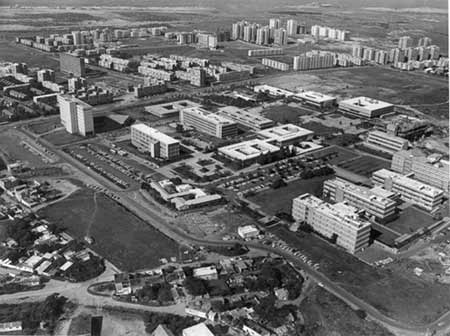
In the early 1970s, I moved to Tel Aviv University as a young master's student. What a welcome escape it was from my undergraduate days as a chemistry student at Hebrew University. The University was young, most of the professors insisted on being called by their first name. Dan Ben Amotz could be seen wandering around campus barefoot (or almost barefoot) on his way to attend Kroy's crazy philosophy lectures.
There were few buildings and lots of sand, mud, and wild vegetation. I remember almost getting hit by lightning walking between life sciences and the medical school.
Over the past thirty-five years the university has sprouted a lot of concrete, and manicured lawns. I think it is a handsome campus. But I liked it better when it had more wild spaces.
I loved and still love our university, lived at the dorms, moved up through the ranks, fell in love on campus, and made it my career. I have also been involved in one of the few inventions that brings the university millions of dollars in licencing revenue.
From the 1970s to the present we have suffered from a string of mostly mediocre and sometimes cynical and self-serving administrations. One consequence was that our university went straight from youth to old age. We have now largely become a city college.
Students come, fill large halls, and go back home at six p.m. At night, when the city lights up, the university closes down. I couldn't even get the administration to consider lighting up the med school at night.
Our students have learned from us to become largely cynical, especially after the last strike. They want their degree, with as little effort as possible. And we oblige, teaching them with as little effort as possible.
I spent twenty years at the Dental School. The School was for many years run like a feifdom, the administration was self-serving, and ruled by intimidation. The teachers and researchers were intimidated by the administration, and took it out on the students. But when I made efforts to alert the University at the highest levels (both academice and administrative) to the situation, I was ignored and silenced. They let sleeping dogs lie until the deficit of the School could no longer be noticed. And then the shit started flying. We are left with half a Dental School, one that never had much of a research program and still does not.
In the Human Microbiology Department of the Medical Faculty where I now work, professors reaching the age of pension have not been replaced by young faculty. Those that have replaced them have mostly either fled or were not given tenure. Within a few years, there will not be any bacteriologists at all in the Medical Faculty. Does anyone care? Not really.
In the American medical program, sometimes five or less students attend classes (out of a class of 70). They say it's because we are not good enough teachers. Does anyone care? Not really.
Are there any staff or students of TAU out there reading this who think that we really care about our students, that we take pride in our teaching, that we care about our own university as much as we did twenty years ago? I challenge you to step forward.
Of course it's easy to blame VATAT and the budget cuts, but that ignores the dwindling return that the public sees on its own investment in our university.
Are we really doing lots of research that is groundbreaking? relevant? important?
Here is another point to ponder. Professors are paid the same salary whether or not they teach well, whether or not they publish research (I know some who stopped doing that years ago). There is no scale of excellence. On the contrary, professors who work hard at the university but also consult on the side (these are probably the more successful and community-oriented ones) actually get paid much less salary than those who profess to spend their 'full time' at the university, whether or not they do anything whilst there.
Mediocre administration breeds mediocre teaching and eventually leads to mediocre research. After all, the students we teach today are doing most of the research five years from now. I know that our university has international stars, but I have the feeling that we are for the most part so-so. It's hard to give a damn when the bosses of your bosses don't. We have suffered over three decades of cynical, mediocre leadership. And this breeds mediocrity in all facets of our campus.
Why should university professors try harder? There are fewer and fewer reasons. Success at our university goes unrewarded, and professors who do 'too well' in basic and applied research can find themselves with problems at the department level, especially when their own department is mediocre and jealous. Our university pays lip service to the need for innovation, but does little to encourage it. It recently rewrote its patent bylaws, and forced them down the throat of the applied researchers throughout the university. Does anyone on campus care? Not a wit.
Weizmann brings in 100 million dollars a year in royalties. Hebrew U about 40. Tel Aviv University? just a million or two (a significant part of it from my own inventions). The numbers speak for themselves.
We do not encourage innovation. The university's most famous and successful innovators have suffered quite a bit of humiliation over the years. The university does not really care. Tel Aviv University does not even send its own professors to give courses on innovation. The two courses on innovation given at Tel Aviv University that I know about are both outsourced! The only way I have been able to give a multidisciplinary course on innovative thinking (together with Dr. Alon Amit) is at Afeka engineering college. I have never be allowed to give such a lecture series on my own campus (I have tried). We have a new president with an outstanding personal record, but I continue to be pessimistic. If, as I stated above, we have relegated ourselves to the level of a city college, then five years from now we will have no raison d'etre whatsoever. After all, the 'michlalot' do a better job at being city colleges than we can. Some of them actually reward and pride themselves on good teaching.