Tuesday, April 29, 2008

The Moral Bankruptcy of Tel Aviv University

Tel Aviv University is having financial difficulties. As a public campus, some of the burden for this lies on the State of Israel, but some of the responsibility lies on the shoulders of those who have been running our university.

One of the most irksome issues is that of applied research. Weizmann Institute brings $100,000,000 a year from royalties of service inventions. The Hebrew University brings $40,000,000 a year. And Tel-Aviv University? Only a few millions a year. In fact, for years, most of their royalty stream derived from three service patents from my own laboratory.

I have been writing to University administrators for years, hoping that they would realize that the continued humiliation and denigration of the few professors who have succeeded in actually developing successful projects is to their own detriment. Our university has a track record of being vindictive towards its own inventors, misappropriating significant parts of their research budgets, and ridiculing their success. No wonder they bring in such paltry royalty streams.

For over twenty years, the university followed its own patent by-laws dating back to 1977. Certain sections were given an interpretation which the university sanctioned over the years. In particular, 20% of the income from patent royalties was directed to the laboratories of the inventors. However, over the past five years, the university has unilaterally begun siphoning off and misappropriating significant amounts of these research funds. According to my calculations, the university owes my laboratory over $250,000 in research funds. For all I know they have been using this money to support unrelated research, 'pet projects' or even to cover the expenses of their own management (or mismanagement, as the case may be). The university recently chose to compose a new set of patent by-laws for new inventions, which are constraining and self-defeating. The attempts of applied researchers all over campus to prevent this unilateral step were largely unheeded. A meeting scheduled months ago with the new President of the university was never held (to the best of my knowledge).

After appealing to every possible address at Tel Aviv University, from the dean of my faculty to the general manager, rector and the president of the university, with no response whatsoever, I have no recourse but to bring this to the public knowledge, by writing a series of monographs, explaining how the university has taken the low moral road. Unfortunately the problem with applied research is just the tip of the iceberg. The university's lack of moral fiber extends to its cynicism in mistreatment of its own students and its donors, and its lack of vision for the future.

I must emphasize that I love Tel Aviv University (but not its administration). My conscience will not allow me peace unless I start telling it like it is. As an employee talking out against his management, I assume that there will be repercussions. But I will no longer be silenced.

Please let me know what you think.

Mel Rosenberg, Ph.D.

Professor of Microbiology

Sackler Faculty of Medicine.


Saturday, April 26, 2008

Lefties in cyprus

I am writing this blog from the Hilton Park Hotel on the outskirts of Nikosia (or Lefkosia, as it is actually called here), Cyprus. A lovely place. It is only a forty minute flight from Tel Aviv, but here one feels as if in a different world, more relaxed, less frenetic. At breakfast today, there was barely the sound of a single mobile phone, which was a welcome relief from the noisy conversations we are used to overhearing, and participating in.

Yesterday I had coffee with two lovely ladies, Themis (from Cyprus) and Clare (from London), both of whom are involved in marketing Dentyl pH mouthwash. We realized early on, that we are all lefties (the chances of three lefties meeting for coffee is about one in a thousand!). All three of us suffered underwent 're-education' according to the viewpoint at the time that being left handed was something that required correction. Themis' story was the most poignant. A the tender age of seven, she was required to fly from Cyprus to London to undergo assessment. Only when she returned with a letter stating that her left-handedness was completely 'incorrectable' was she allowed to go back to school here and write with her sinister hand.

In kindergarten, they didn’t tie my left hand behind my back (I think I might have recalled such instances), or send me to London, but I do remember them repeatedly taking the crayon from my right hand and putting it into my left. Last weekend, while I was looking for something else, I chanced upon my kindergarten report card, which I 'proudly' display herewith.

I must have been a pretty miserable little guy. In addition to being wrong handed, and the only Jewish in a kindergarten which prayed daily to Jesus, I was hyperactive decades before there was a 'diagnosis' for this sort of thing. Fifty years later, living in a country where most people are Jewish, being left handed is no longer a sin, and practically everyone is frenetic and hyperactive, I feel quite at home.

Nevertheless, Cyprus is a welcome respite! Last night I gave my talk on bad breath to about 150 Cypriot dentists. One of my conditions in coming was that they set up a jazz gig with local musicians. This they indeed did, with excellent musicians, but this was at the dental event itself. So I found myself playing sax, singing, lecturing for an hour, then playing sax again. Lots of fun. Nevertheless, I got the feeling that the locals prefer Greek music (eventually a Greek band came on, and they were very good).

Thursday, April 17, 2008

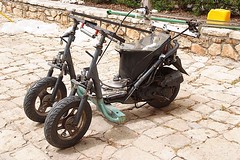
Kinnernet2008-skatemobile (front section)


Kinnernet2008-552
Originally uploaded by Herbert Bishko
This is our skatmobile, based on an idea i had that originally didn't work, but into the limelight stepped up my friend and great genius Hagai Cohen, who invented a new steering mechanism. We test ran the new skatemobile at Kinnernet 2008, it actually works and is like waterskiing on land. Tons of fun. Stay tuned!!!!

Kinnernet2008


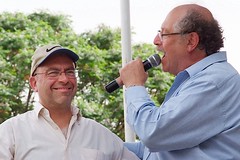
Kinnernet2008-594
Originally uploaded by Herbert Bishko
With the man himself, the one and only King and Ruler of Kinnernet (not to mention originator, organizer and visionary) Yossi Vardi

Monday, April 14, 2008

48create - creative thinking method

About two years ago, I was approached by the President of Afeka College, Prof. Moti Sokolov. He had heard (quite correctly) that I was interested in taking a sabbatical, and teaching an interdisciplinary course at the undergraduate level. This is practically impossible at large, conservative, departmentalized universities, but Afeka is a top notch community college, focusing on engineering students.

The topic which we decided upon was "multidisciplinary creative thinking". Moti's stipulation was that the course be given in English. I happily agreed.


To develop and present the course, I enlisted my right hand man (literally, being left-handed myself), Dr. Alon Amit. Alon a young man of multiple talents and pursuits: internet whiz, dentist, cook, entrepreneur and chocolate aficionado, inter alia. We found that there are over fifty different techniques for creative thinking available. After looking at many of them, we decided to develop our own interactive course, bringing together a unique mix of internet and science, poetry and patents, copy writing and technology.

There were several important features of our course:

Fun, silliness and active participation were encouraged and pursued. Applause and praise were welcome; constructive criticism was tolerated. Each student was issued with the name badge of a famous pseudoparticipant. Thus, during the course, each student went by the name of his/her particular namesake: Sir Isaac Newton, Margaret Thatcher, George Gershwin, etc.


Most of our 'get togethers' were composed of a mosaic of different 'corners', including

  • vignettes from movies and advertising
  • inventions with 'legs'
  • famous innovators (this included writers and musicians as well as inventors)
  • riddle solving and composing
  • trying to improve erstwhile mundane objects and processes
  • show and tell

A few of the lectures were more focused, and less interactive, relating to specific subjects, such as

  • protection of ideas
  • current methodologies for creative thinking

We often wandered off the game plan, allowing ourselves to meander laterally on a wide variety of tangents. For example, a word which the students didn't know might lead us to a poem, song or website (we were online the whole time). These unanticipated outings were great fun and engendered the lots of creative thinking. If Alon and I otherwise discovered a classic movie, poem or innovator that the students were unaware of (for example Andrew Marvell's marvelous "To a Coy Mistress"), then the students were instructed to seek out the poem and we read it together during the next class. We 'rediscovered' Tom Lehrer, Monty Python, and Bing Crosby, just to name a few. They also brought in their favorite inventions, video and audio clips.

To get a high mark, students needed to actively participate in class and via e-mail during the week. They would get 'bonus points' for anything and everything clever, original and funny. The course assignment was to submit a written proposal for an innovative restaurant.

I must admit that we didn't anticipate how successful the course would be. The 40 engineering students that participated in the course had vivid imaginations, were great in lateral thinking (when encouraged to do so), and rose to the many challenges of the course. They developed splendid and sometimes hilarious ideas for innovative companies, improved existing products, invented restaurants of all kinds and shapes.

During the classes, we discovered that certain approaches worked better than others.

For example, we found that in order to 'think outside the box', it helps if you have a box. We discussed various ways that you can modify a product or process (e.g., changing various physical properties). But the students' and our own ability to think of new innovations worked best when we gave them examples of things to change.

This led us to the development of a very simple process which we now call "48create". According to this method, we give the students a list of 48 ways to change the world, and 48 things to change (of course the ways and things can both be modified and adapted).

Then we pick (randomly, or on purpose) several from each list. So, for example, the things we might want to change might be:

  • Coins
  • Ping pong ball
  • buttering bread
  • Parking space

The four ways might be:

  • Color
  • Direction
  • Frequency
  • Size

The advantages of this technique are its simplicity, and that it works. I tried it out at the University of Toronto last September, and within a few minutes, science students were busy discussing new (and very ingenious!!) of keeping maple syrup from rolling off buttermilk pancakes.

One important aspect of the technique is that it is open ended: it seeks to foster creative thinking and innovation per se. It is not aimed towards solving a specific problem at a given time, but rather to get the creative juices flowing.

Why don't you give it a try and let us know whether it works for you? Forty-eight ways to change the world, and forty-eight things to change are available at 48create.com

And yes, of course, please feel free to add your own ways to change the world, and other things to change. That should make it even more fun!


Sunday, April 13, 2008

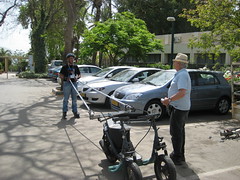
Our new mobile vehicle


Hagai Cohen
Originally uploaded by rafael_mizrahi
With Hagai Cohen, test driving last weekend at the kinneret - Doesn't it look cool?