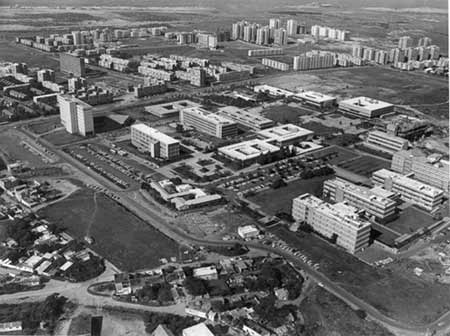
Let me start out by stating clearly that the problems of Tel Aviv University which I will be discussing are as much my fault as anyone else's. I wouldn't like to give the impression that I am blaming others, I think we are all to blame.
In the early 1970s, I moved to Tel Aviv University as a young master's student. What a welcome escape it was from my undergraduate days as a chemistry student at Hebrew University. The University was young, most of the professors insisted on being called by their first name. Dan Ben Amotz could be seen wandering around campus barefoot (or almost barefoot) on his way to attend Kroy's crazy philosophy lectures.
There were few buildings and lots of sand, mud, and wild vegetation. I remember almost getting hit by lightning walking between life sciences and the medical school.
Over the past thirty-five years the university has sprouted a lot of concrete, and manicured lawns. I think it is a handsome campus. But I liked it better when it had more wild spaces.
I loved and still love our university, lived at the dorms, moved up through the ranks, fell in love on campus, and made it my career. I have also been involved in one of the few inventions that brings the university millions of dollars in licencing revenue.
From the 1970s to the present we have suffered from a string of mostly mediocre and sometimes cynical and self-serving administrations. One consequence was that our university went straight from youth to old age. We have now largely become a city college.
Students come, fill large halls, and go back home at six p.m. At night, when the city lights up, the university closes down. I couldn't even get the administration to consider lighting up the med school at night.
Our students have learned from us to become largely cynical, especially after the last strike. They want their degree, with as little effort as possible. And we oblige, teaching them with as little effort as possible.

I spent twenty years at the Dental School. The School was for many years run like a feifdom, the administration was self-serving, and ruled by intimidation. The teachers and researchers were intimidated by the administration, and took it out on the students. But when I made efforts to alert the University at the highest levels (both academice and administrative) to the situation, I was ignored and silenced. They let sleeping dogs lie until the deficit of the School could no longer be noticed. And then the shit started flying. We are left with half a Dental School, one that never had much of a research program and still does not.
In the Human Microbiology Department of the Medical Faculty where I now work, professors reaching the age of pension have not been replaced by young faculty. Those that have replaced them have mostly either fled or were not given tenure. Within a few years, there will not be any bacteriologists at all in the Medical Faculty. Does anyone care? Not really.

In the American medical program, sometimes five or less students attend classes (out of a class of 70). They say it's because we are not good enough teachers. Does anyone care? Not really.
Are there any staff or students of TAU out there reading this who think that we really care about our students, that we take pride in our teaching, that we care about our own university as much as we did twenty years ago? I challenge you to step forward.
Of course it's easy to blame VATAT and the budget cuts, but that ignores the dwindling return that the public sees on its own investment in our university.
Are we really doing lots of research that is groundbreaking? relevant? important?
Here is another point to ponder. Professors are paid the same salary whether or not they teach well, whether or not they publish research (I know some who stopped doing that years ago). There is no scale of excellence. On the contrary, professors who work hard at the university but also consult on the side (these are probably the more successful and community-oriented ones) actually get paid much less salary than those who profess to spend their 'full time' at the university, whether or not they do anything whilst there.
Mediocre administration breeds mediocre teaching and eventually leads to mediocre research. After all, the students we teach today are doing most of the research five years from now. I know that our university has international stars, but I have the feeling that we are for the most part so-so. It's hard to give a damn when the bosses of your bosses don't. We have suffered over three decades of cynical, mediocre leadership. And this breeds mediocrity in all facets of our campus.
Why should university professors try harder? There are fewer and fewer reasons. Success at our university goes unrewarded, and professors who do 'too well' in basic and applied research can find themselves with problems at the department level, especially when their own department is mediocre and jealous. Our university pays lip service to the need for innovation, but does little to encourage it. It recently rewrote its patent bylaws, and forced them down the throat of the applied researchers throughout the university. Does anyone on campus care? Not a wit.
Weizmann brings in 100 million dollars a year in royalties. Hebrew U about 40. Tel Aviv University? just a million or two (a significant part of it from my own inventions). The numbers speak for themselves.
We do not encourage innovation. The university's most famous and successful innovators have suffered quite a bit of humiliation over the years. The university does not really care. Tel Aviv University does not even send its own professors to give courses on innovation. The two courses on innovation given at Tel Aviv University that I know about are both outsourced! The only way I have been able to give a multidisciplinary course on innovative thinking (together with Dr. Alon Amit) is at Afeka engineering college. I have never be allowed to give such a lecture series on my own campus (I have tried). We have a new president with an outstanding personal record, but I continue to be pessimistic. If, as I stated above, we have relegated ourselves to the level of a city college, then five years from now we will have no raison d'etre whatsoever. After all, the 'michlalot' do a better job at being city colleges than we can. Some of them actually reward and pride themselves on good teaching.
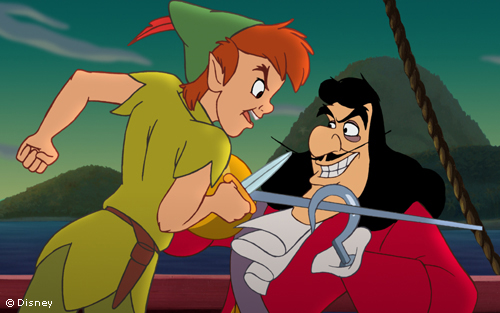 Some of the children's books Dad read to me remain stuck in my brain fifty years later. First, I remember that we had two different Peter Pan stories, each by a different illustrator. This drove me crazy. "Daddy", I would plead, "which of these pictures is the REAL Peter Pan?". Disney's movie, Peter Pan appeared the year I was born (1951), and I have seen it many times. At the beginning it gives thanks to the hospital for sick children on


