Saturday, April 21, 2007
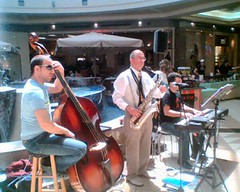
Friday morning gig
Wednesday, April 18, 2007
Smelling well
Of all our senses, smell is the most mysterious. We can detect thousands of different odors, yet have trouble naming them. Although dogs are better sniffers than we are, the molecular receptors in our noses are remarkably sensitive. Certain molecules can be sensed and identified, even when they are surrounded by ten million molecules of regular air (or more!).
Smell is intimately related in our brains with memory. That is why a smell can sometimes evoke a distant memory from childhood that would otherwise be lost in the sands of time.
Smells are also intimately involved with our adult sexuality. Like other animals
, we also judge potential mates by their body odor. Perhaps that is why, for thousands of years, we have been preoccupied with perfuming our bodies. Usually, for this purpose, we employ extracts of flowers (which are actually the sex organs of plants) or attractive odors from the scent glands of animals (musk). Perfumes are a multi-billion dollar business. Oddly enough, many of the aromas used in fragrances these days are synthetic, and are manufactured using petroleum as a starting point.Natural body odor can be a sexual turn-on (I agree with Desmond Morris on this), but in modern "civilized" society, body odor (commonly referred to as "b.o.") is generally considered offensive. Most body odor comes from the armpits ("axilla"). In primitive society, molecules wafting from our armpits probably conveyed a variety of behavioral signals (we call such molecules 'pheromones'). Scientists are currently studying this subject, and have found that armpit secretions can modulate menstrual cycles in other women. They may also affect physiological properties and brain activity. So "b.o." may not be as bad as we think. Some scientists (myself included) think that the adult armpit is like a radio station, in which the axillary hairs are smell antennae that emit a variety of sexual and other messages that we may not even be aware of. Since the smell that each of us emits is unique and related to our wellbeing and genetic makeup (as with animals), our smell 'fingerprint' may help us identify suitable mates. It may also serve as an identification mechanism in the future. Most people (especially women, who smell better than men) can pick their mate's t-shirt out of a heap of clothing worn by strangers.
Most offensive odors are the product of microbial activity. Microbes cause bad breath, body odor, foot and shoe odor, wet towel odor, the stench of feces and sewage, and the smell of rotten food. Some scientists think that our aversion for these smells may be a primitive warning sign to avoid dangerous food and water, and to stay away from others with infectious diseases.
Our life experiences also conditions our smell preferences. We bond with our mothers by smell shortly after birth. We learn to love the odor of a good cheese, even when it smells like an open sewer. People who grew up on a farm, may even long for the odor of a barn or chicken coop.
Commercial companies know just how important smell is in our makeup. They turn scents into dollars by adding attractive fragrances to practically everything. They trick us into spending more money in supermarkets and malls, convince us that instant coffee is as good as the real thing, and even upgrade lousy whiskeys.
Smells, despite their great importance, are elusive. They don't have names like colors do. We say, "That smells like a …" And scientists around the world are still searching for that attractive molecule that will make us irresistible mating partners. Stay tuned, and keep on smelling.
Tuesday, April 17, 2007
On the Fly
"The Lord in his wisdom made the fly/And then forgot to tell us why."

I don't know why
I'm just a fly
I could have been a horse, of course,
A singing sow, a mellow cow,
I might have been an elephant
Or even more significant
ly
Mother Goose or fluffy Eider
Muffet's friendly little spider
A meely eel
A clapping seal
A heavy wren
Or even just a lousy louse
On the collar of a mouse;
But then again
There has to be
A reason why
A high
er
purpose
to reveal
Why I am not an ancient tortoise
Butterfly
Or any porpoise.
Someday I know
As cold winds blow
I shall grow old
So I've been told
On my last wings
While angels sing
The Cherubs sigh,
They shall draw nigh
Into my ear
The secret dear
They will
convey
The reason why
I'm just a very

Thursday, April 12, 2007
Taking some control over one's own health
We teach our medical and dental students to deal with disease, but we never stop to consider whether there is one standard definition for this word. Wikipedia's current definition of disease is:
The term 'disease' refers to any abnormal condition of an organism that impairs function. In human beings, "disease" is often used more broadly to refer to any condition that causes discomfort, dysfunction, distress, social problems, and/or death to the person afflicted, or similar problems for those in contact with the person
I spend considerable time talking with my students about what constitutes a disease? Is having a stuffy nose a disease? According to the definition above, it is an abnormal condition, impairing function, and causes discomfort. What about a 'hangover', a 'blister', a 'beesting', even a 'mosquito bite'. Each of these would fit the above description, although few of us would refer to these abnormal conditions (causing discomfort) as disease.
In extreme cases, of course, such as unfortunate people with terminal types of cancer, heart failure, etc., there would be much consensus. But what about all the physical challenges in between? Do they constitute disease.
Some people cope better with a cold or the flu than others. They get up, go to work, and do not consider themselves as disease-ridden. Others run to their doctor for prescriptions, get into bed and moan for days.
So what constitutes a disease is actually in the eyes of the beholder. A life-threatening disease for one may be just a bad hair day for another.
Which brings me to the topic of today's posting. I think that people today do not seek enough control over their own health. The moment they feel unwell, they run to the doctor. If the doctor prescribes medication, they take it. If the surgeon recommends surgery, they go under the knife (or lapyroscope, these days). If the dentist tells them they need sixteen teeth capped, so be it.
But physicians are only human and they don't always get it right. By the way, not all of what we teach them in med school turns out to be correct in the long term. Medications and procedures come and go. Vitamins are in one year, out the next.
That doesn't mean that you shouldn't go to the doctor, especially if you are feeling extremely bad. But sometimes your body can fix itself and sometimes you can play an active role.
I am inventor, and when I am not feeling well, I sometimes try to find my own ways of feeling better. If I fail, I go see a doctor. But I've succeeded twice, and lived to tell. So here it is:
About twenty years ago, I had terrible rectal pain and bleeding. Defecation was unbearable. Sitting was tortuous.
I made a date to see a proctologist (actually a tremendous fellow, Prof. Wishnitzer, I should write about him someday) who was the Dean of the Medical Faculty and had accepted me as a young lecturer in 1982. I went to his office and entered his waiting room. There were lots of people waiting. All of them were standing. There wasn't a single chair, who could use one? So I stood and waited and thought to myself: "I'm waiting to see a proctologist. He is a surgeon. Surgeons perform surgery. He's going to operate on my tuchus (ass) !"
I hurried home, and the terror of having my rectum restructured prompted me to experiment. To make a long story short, I found that just by sitting in a different position on the toilet seat, I could greatly ease the pain and discomfort. The bleeding disappeared, and I have been fine (at that end of my body) for years. (Again, please don't misunderstand. If the bleeding had continued, I would have gone back within a few days.)
The second story has to do with my esophagus. When I was 40 I started to have terrific reflux pains. I would awake in the middle of the night, choking on regurgitated food coming out of my nose. It turns out that I have something called achalasia. It's a rare problem in which the nerves of the esophagus don't communicate with the muscles telling them to push down the food into the stomach (peristalsis). So the food just hangs around in the esophagus, the sphincter at the entrance to the stomach goes into spasm (like a clenched fist), and food can go up, but not down. That summer of 1993, I flew to a scientific meeting with my wife, and ended up throwing up all over Rhode Island and Boston. Some of you may have noticed. I went from being chubby to emaciated, and had to be rescued by something called "pneumatic dilation". Which means that doctors stick pipes down your throat, and blow up a balloon which rips and tears the muscles of the sphincter. It's an excrutiatingly painful process, and to make it worse, they don't put you under (they need you awake in case they perforate your esophagus, in which case you are in danger and need a quick operation). This procedure eventually allowed me to recover some of my weight and stamina. But after seven or eight years, the troubles returned (the doctors neglected to tell me that this is what usually occurs) and I was back to my old puking self. So I went to see the most prominent surgeon in the country who does these kinds of things. "We'll do a new operation" he suggested (I hate 'new' operations, it makes you feel like such a guinea pig), " called a Heller myotomy where we'll make five incisions in your sphincter, and then do a fundoplication, stapling a part of your stomach around the sphincter. You'll feel like a million bucks".
Yuck! So my resentment of having physicians turn me into a Lego came into play. I tried everything. Yoga, diet, stretching, bending, you name it. And I hit on a solution. I found that just by eating a bit of dark chocolate (at least 70%, better 80% or more) before meals, I could get the food down with (relative) ease. I must admit that my being a scientist helped out here. Chocolate is a drug (a highly benevolent one in my opinion if you use cocoa or extremely bitter chocolate) that affects the nerves in the body. Probably, the same way that it causes other people heartburn (by relaxing the sphincter at the entrance to the stomach) by allowing acid to pass upward, in my case, it allows the food in my esophagus to go downwards. So people with achalasia, wherever you are, take heart. Try cocoa or bitter chocolate right before meals, and let me know. And feel free to e-mail me for more suggestions.
Interestingly, very religious Jews have a different way of doing things. When someone is ill, I mean really life-threateningly ill, they do not go directly to the doctor. What they do is go to the Rabbi. In the Jewish religion, it is the duty of the Rabbi to find the best solution, medical or otherwise. Here in Israel, the greatest maven in grave health problems is Rabbi Fuhrer. Hospitals confer with him. He literally searches the world for the greatest expert for a given problem. I am not advocating that everyone do this, just sharing.
Finally, we have a lot more control over our health than we realize. Do we exercise enough? Do we sleep enough? Do we laugh enough (good medicine for many things)? Do we love enough? Do we eat too much of everything, especially fats, sweets and salt (which are primitive needs of our ancient biology)? Do we smoke too much? All these are factors that we can control, and which have more influence over our health than many medications and interventions.
Thursday, April 5, 2007
What I do for a living
mells their breath!"). When I was that pudgy kid growing up in Ottawa, I originally wanted to be an astronomer. But I ended up doing my Ph.D. in microbiology. When I joined the dental faculty of Tel Aviv University as a young lecturer in 1982, I wanted to do something new, but didn't know precisely what. At the time we were commencing work on our two-phase mouthwash project and someone told me to check whether it worked against bad breath. I went to the library and found that very few academic scientists (Joe Tonzetich at UBC, Ken Yaegaki in Japan, and maybe one or two others) were working on this very common and embarassing problem. I remember coming home that night and telling my wife that I had stumbled onto my scientific future. Indeed, I've been very lucky. We developed a method for measuring the volatile sulfides associated with bad breath (the Halimeter) that is used in laboratories and clinics around the world. In
addition, the reformulated two-phase mouthwash (Dentyl pH) has taken off in the UK and is a highly successful product there. I was also fortunate enough to write an article on bad breath for Scientific American in 2002. These days I'm on sabbatical, writing a book on bad breath (following two edited scientific texts) for the public, working on our new website (www.smellwell.com), and trying to get our anti-odor flavor ("Breathanol") into more products in more countries. In August, I'll be joining scientists from around the world at the 7th international conference on breath odor, which will be held in Chicago. This is especially exciting for me as I co-founded this society in 1996 with Prof. Daniel van Steenberghe, and we have watched it grow and develop. These days, Alon Amit and I are working on fixing the entry for bad breath in 'wikipedia'. The current one really stinks (literally as well as figuratively). It will be interesting to see whether they accept a more scientific, less commercial version. Stick around to find out soon.
Wednesday, April 4, 2007
Passover, Easter, Judaism, Christianity
Back to Passover. Who knows whether the Israelites were in Egypt, whether they wandered around for forty years, and how they received the ten commandments and entered the Promised Land. Is it all that important to 'know' what cannot be known? But like millions of Christians and Jews around the world, I was brought up on these stories and I love them. I don't spend too much time pondering what actually happened. But anyone coming to visit me in Israel can visit the Jordan river, which is not "deep and wide" nor "chilly and cold", but rather a slowly meandering creek. In Canada, it wouldn't even merit a name.
Growing up as a semi-observant Jewish kid in Ottawa, we were not allowed to read the New Testament, learn about Christianity (or evolution), sing Christmas caroles (I once almost got thrown out of class for refusing to sing Christmas songs in Latin). How myopic in retrospect. The older I get, the clearer it becomes that Christianity and Judaism are practically the same religion. People with anti-semitic tendencies should remember that Jesus was a Jew, followed Jewish traditions, and preached among Jews. He never met a Christian his whole life. He celebrated the Jewish New Year, fasted on Yom Kippur, and I suppose he was circumcised according to Jewish traditions. As a boy, he played with Jewish kids.
My soul mate in Canada is Chris McCulloch. I will dedicate at least an entire post to this remarkable guy. He changed my life. While on sabbatical at the University of Toronto almost twenty years ago, Chris invited my wife to Easter mass. I wouldn't go , but my wife, having grown up in Israel and free of the teachings of Canadian rabbis, or fear of assimilation, went and enjoyed herself. Chris and I spent a lot of time talking about religion. It turns out that Christians are essentially people who believe the same basic things we Jews do, but have evolved some analogous rituals, observe a similar Sabbath on the next day, and celebrate Easter instead of Passover. Christians think that Jesus is the son of God, and will return someday. That's fine with me. But because I grew up in a Jewish household, I think that he was a rabbi. I don't know anyone in the living world who knows the answer to this one. So the point I'm trying to make is that people should live and let live. If believing in God makes you a better human being, great. If going to church or synagogue makes you a more benevolent person, wonderful. If celebrating Easter or Passover makes you a generous and loving mortal, wonderful. For me, that's what it's all about. By the time every one of us finds out if there really is a supreme being and/or an afterlife, it may be too late. So my recipe for all you Christians and Jews who have very similar beliefs and may or may not know it, is as follows: Live a good life according to the teachings of Jesus and Hillel. Treat thy neighbor well. Do good deeds. And when you die, one of two things will have happened. Either you'll have lived a decent and worthy life, without the angst of having gone against your upbringing, and will be justly rewarded by the Supreme Being, or you'll have to settle with the reward of having had a rewarding life. But to quote that song from Blood, Sweat and Tears, "I'll never know by living, only my dying will tell..."
So I try to be a decent person (not always successfully, I am ready to admit), I go on eating my Passover matzos and shunning leavened bread for a week each year, not knowing whether there is any truth in the Exodus story, but loving it anyway, and reliving it every year, with parents and kids.
Happy holidays, friends.
Kinnernet 2007 memories and musings
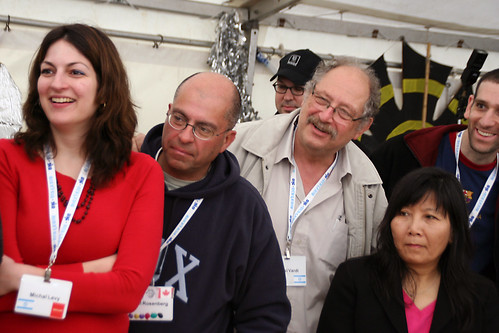
t otherwise harmless people. The camp 'director' Yossi Vardi (to the right of me in photo), kindly invited me, despite my limited understanding of all things internet (I suppose I belong tothe second category of invited). The three-day camp (some call it an 'unconference') was a smashing success (some smashed computers, some got smashed, some did both). At Kinnernet, I was a member of the band (on tenor sax) led by the amazing Michal Levy (on left in photo) and gave a talk on bad breath, body odor and sex, which is something I do on occasion (give talks, that is). During the daytime, I study bad breath and body odors, as a university professor and inventor. At nighttime, I turn into a sax player and singer (mostly nostalgiac jazz and some rock and roll). During the rest of my spare time, I like to write children's books. Which brings me back to Kinnernet 2007. For the past 25 years, I have been considered something of an u
gly duckling by my academic 'friends' who think I should be spending more time among test tubes and less time with my otherpursuits. But I think that life is all about doing many things simultaneously. So imagine how very at home I felt among some 200 other Kinnernet campers whowere like me, but much moreso.In my previous post, I told you a little about little Ottawa (there is much more to tell) where I grew up as a young, chubby, nerd of a kid. Among my first grade colleagues was a girl named Selma Tennenhouse. Her baby brother David, (who was actually a baby the last time I saw him, almost fifty years ago) was a fellow Kinnernet camper, now a computer guru. Quite a coincidence running into him. By the way, I also have a baby brother, also named David, who has turned into a very successful and amazing guy. Hag Pesach Sameach, David! (Which, for all of those readers who aren't Jewish, have no plans to become Jewish, don't know Hebrew, etc., means Happy Passover).
More on Passover, Judaism, Christianity and life in my next post. Regards to all,
Mel
Sunday, April 1, 2007
MVFP (my very first post...)
This is my first post, so please be kind. First, I'd like to thank my manager, Alon Amit, for setting it up so quickly. What I hope to do here is discuss various aspects of my personal, scientific and musical life in the hope that it is of some interest or benefit to others.
I was born in Winnipeg and grew up in Ottawa, at a time when there were only six teams in the NHL, and the CFL was much more popular in Canada than American football. I loved going with my Dad to Landsdowne Park, becoming intoxicated with the cigar smoke, and watching the Roughriders clobber the Hamilton Tiger Cats. We used to go for lime-flavoured ice cream at some small dairy right in town, I wish I could remember its name.
I attended Hillcrest High School, the school was just a few years old when we started. For some reason, I declined to study music, and 'majored' in things like woodwork. I was a total disaster in woodwork and still can't hammer a nail into the wall without injuring the wall, the nail or my finger (hammer remains intact, though). I studied with some very talented kids, and wonder whether any went on to have illustrious careers.
I left Ottawa after grade thirteen (does that still exist anywhere?) and came to Israel for one year. That turned into a very long year, and with the exception of a year in Toronto on sabbatical, have lived here practically ever since.
Some seven years ago, during one of my visits abroad to talk about bad breath (what I do for a living, along with smelling people), I met some people from Ottawa at a tiny train station in England (somewhere near Chester, the name will come to me). They told me that Hillcrest had become one of the best high schools in Ontario. In grade nine I did really well on a math competition and received a slide rule (who remembers what that thing is?) from none other than Russ Jackson. Turns out, I had a lucky day, and bombed out in subsequent math competitions. I have really fond memories of a lot of teachers at that school, particularly Ken Crouch (I understand he won the prime minister's award, he deserves it) and E.W. Benoit who turned a bunch of science nerds into lit lovers.
I studied classical piano with Sandra Coupal on Daly Street. I was taking a piano lesson when John F. Kennedy was assasinated. Isn't it funny how you remember exactly where you were on that day, at that hour? Sandra was a great and demanding piano teacher, I learned recently that a prize is awarded in her name each year. Sandra had a fantastic student (I think his name was Frank Parkinson) who began piano at sixteen and was wonderfully talented. Within three years he learned to play "Rhapsody in Blue" and performed with our teacher at the concert she organized every two years at Academic Hall. The very next day, Frank stopped taking lessons. It turned out that he had this dream to play this particular piece, he succeeded, and that was that. This is one of the poignant stories of my youth. Where are you today, Frank? Have you gone back to the piano?
Anyway, this was (at the age of ten) my first exciting exposure to George Gershwin and jazz. Too bad I didn't follow up on it till I was twenty. I guess it was just one of those things.